0
0
 0
0
The natal chart, a circular map of the sky at the moment you were born, is one of the most sophisticated tools for self-understanding humanity has ever developed. A well-read natal chart can describe things about you that you thought only you knew. But it does not tell you something crucial: where are you living those patterns? Where are you embodying the planets, not as ideas, but as lived experience? That is where Local Space begins. The natal chart is an ecliptic map of the sky. Local Space re-orients it to the local horizon, the directions around you.
I remember the first time I was exposed to Astro*Carto*Graphy (ACG). I was in a bookstore, looking in the gently used section, and came across recordings from an extended weekend retreat by Arielle Guttman and Robert Hand. Because I had moved around quite a bit in my life, I became obsessed with this system that maps planetary lines across the Earth, showing where planets become angular, rising, setting, culminating, and anti-culminating. It is powerful, and it works beautifully for relocation and travel.
At the time, I was also deeply engrossed in feng shui and energy work. I kept thinking: there must be a Western astrological way to organize the planetary expressions oriented to directional energy.
That is when I found Michael Erlewine, Steven Cozzi, and Martin Davis’s work on Local Space. It had already been done. Local Space became real for me because it fit my understanding of the power that comes from embodying the planets as a ‘feet on the ground’ experience.
I generated my Local Space map and did what many students do on day one: I laid it over the floor plan of my home. I expected it to be interesting in the way astrology is often interesting, symbolic, and subtly interpretive.
Instead, I felt an immediate shift. It was as if the map were looking into my deep, private thoughts. A direction in my house that I had always found strangely calming, without ever knowing why, fell right on a line that made perfect sense of it. Another area that reliably agitated my system, a place I would avoid without a reason, had a different planetary signature running through it. Suddenly, my home was not just a collection of rooms. It was a living field of relationship between me and the sky, expressed through direction. Walking through my home with the map was eye-opening. Even where the clutter magically gathered made sense.
That experience changes how you practice astrology.
Local Space takes the chart from an ecliptic view, planets measured along the zodiac, to a horizontal view, planets related to your horizon and the directions around you. In other words, it takes points in the sky and turns them into directions on the ground.
At the moment you were born, every planet occupied a specific place in the sky. If you had been standing outside, you could have physically pointed to where the Sun, Venus, and Saturn were, each in a specific direction. Those directions were real. Local Space translates them into a personal compass map. Each planet becomes a directional line radiating outward from your location like spokes on a wheel, each with its own precise compass bearing. When altitude is included, how high above the horizon a planet sits, you also begin to understand how accessible each planetary energy is from where you stand.
Because the map can be recast for any location using your birth moment, your chart becomes something you can walk. This is why it is called Compass Astrology.
AstroCartoGraphy Versus Local Space
ACG maps where your planets become amped up by angularity across the globe. Local Space maps how those same planets radiate from you as directional axes wherever you are. This allows you to orient your physical body with the planets themselves on the landscape.
One asks: where in the world does this planet get loud? The other asks: how does this planet meet me through the directions of my everyday life?
Direction Carries Meaning. Ancient Traditions Knew This.
Local Space restores an ancient understanding: we are part of our landscape. Across cultures, people aligned their buildings and rituals to the sky and the compass. Feng shui refined a practical art of orientation. Vāstu Shastra mapped directional intelligence into design. Indigenous traditions treated the directions and landscape as living teachers. Modern life flattens direction into convenience; we use it as an operating system that tells us how to get somewhere. But the older view is different: direction is a relationship, and destination is an embodied experience, a conversation between sky, land, and human awareness.
Local Space personalizes that conversation. Your East may carry your Sun line, or your Saturn line, or your Venus line. The planetary signature transforms East into something uniquely calibrated to your chart and your life. When you map Local Space onto your home, spaces you have lived in for years start to reveal themselves.
The corner where your morning practice always goes deeper might fall on a supportive line. The room where you do your most focused work might sit on a Mercury axis. A place where you consistently feel restless or reactive might be a Mars corridor. A dreamy, porous, where-did-the-time-go zone might carry Neptune.
The practice begins with the wide lens and then zooms in. The landscape around you is not a backdrop. It is a field, and the planetary lines running through it are part of the exchange you are participating in every single day.
Here are a few examples of how the landscape answers a line. A line running into open fresh water often feels amplified, reflective, emotionally resonant, and nourishing. A line running into high ground can feel supported and contained, like a planet has backing and steadiness behind it. A line running along high-traffic corridors or dense electromagnetic infrastructure can feel agitated, not because the planet is bad, but because the environment complicates its expression. And yes: a grocery store on your Neptune line can create a foggy drift where you come home with everything except what you went there for.
This is where Compass Astrology becomes three-dimensional. You are not only reading a planet. You are reading a relationship, and not just any relationship. No two people standing in the same room are reading the same field. The planet, the direction, and the land are always filtered through you.
The conclusions are not abstract. You may understand why one direction of your life feels chronically difficult, why another feels naturally resourced, or why a goal thrives only when you physically position yourself in a different part of your environment. Even your position in the boardroom or at the dining room table can be more supportive when you know what the best planetary line and direction are for you.
Going With the Flow
A common misconception is that Local Space means you need to move house, rearrange everything, or turn your life into a ritualized architectural project. It does not. In today’s world, where a company or a partner can ask you to move across the country or the world, you do not always have the luxury of choosing your ACG line. The Compass becomes the working palette for co-creating your experience wherever you land.
Compass Astrology consists of the Natal, Relocated, and Compass charts together. From there, small experiments can enhance your living experience and let your own system provide feedback.
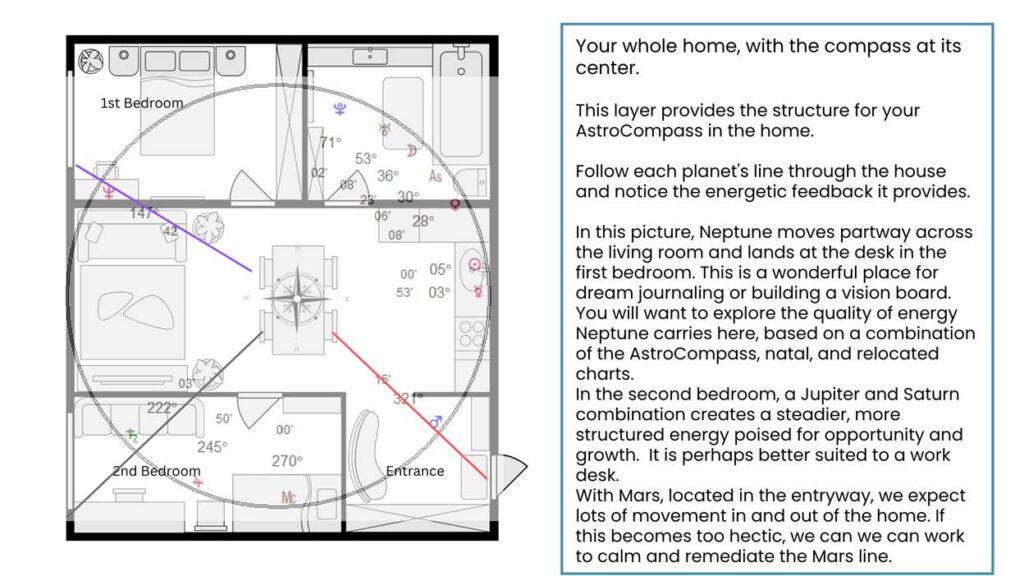
At one end of the spectrum, the practice can be beautifully simple. Place a warm light or gold object along your Sun direction. Put a green plant or notebook in your Mercury direction. Create a Venus altar that reflects your values and goals. Keep your Saturn direction clean and structured if you want stronger boundaries. These are not trivial gestures. They create real effects because your nervous system is not separate from space. You are always in a relationship with direction, light, sound, and orientation.
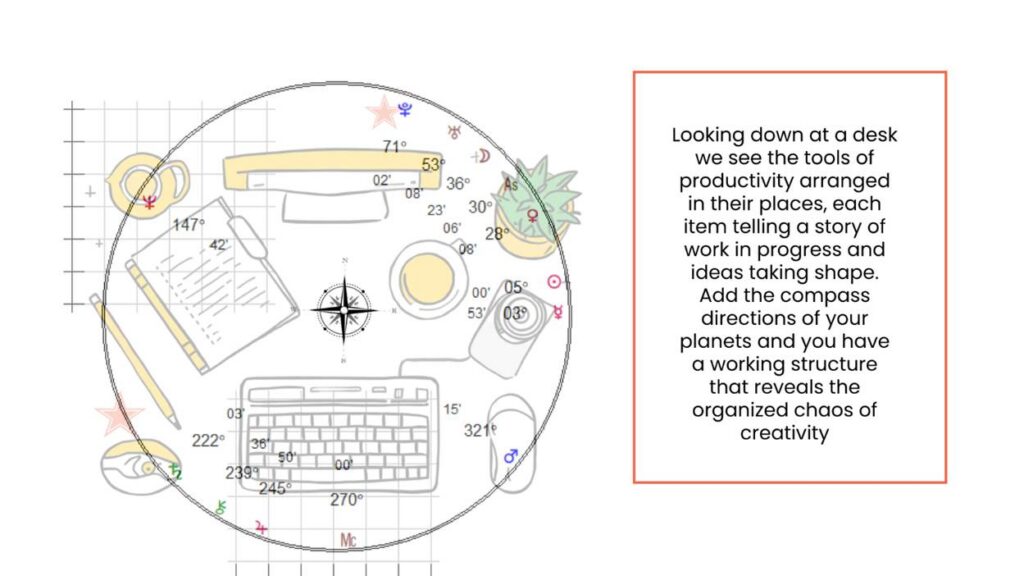
Here is an example of a micro compass you could easily work with at your desk.
At the deeper end is a lifelong art: refining perception. Over time, practitioners begin to feel a room’s directional field as they walk into it. This is not supernatural. It is human capacity developed through practiced attention, like any craft.
Why This Matters Now
We are at a remarkable point in time. The ancient spatial traditions are being recovered and refined. The science of consciousness is converging on the same recognitions that those traditions reached through entirely different means. And the collective hunger for a more conscious, embodied, reciprocal relationship with the places we live in is palpable in ways it has not been for generations.
Local Space and Compass Astrology offer a precise doorway into that relationship. They show you where your planetary energies move through your landscape and home, where the exchange supports you, and where it is asking for your conscious attention.
Your home is already talking.
Your landscape is already responding.
The planetary lines are already running through your rooms and your neighborhood.
The only question is whether you are ready to listen.
Tamira McGillivray is a Canadian astrologer and educator specializing in AstroMapping and Local Space (Compass Astrology). She serves on the Kepler College Board of Directors and Administration Council and works as an instructor and Education Coordinator. She also teaches meditation and energy work, exploring how environment, orientation, and embodied attention shape experience. You can reach Tamira via email Astro@tamira.ca, Website: TamiraMcGillivray.com